
You do not need to rebuild your entire help centre before testing in-app AI support.
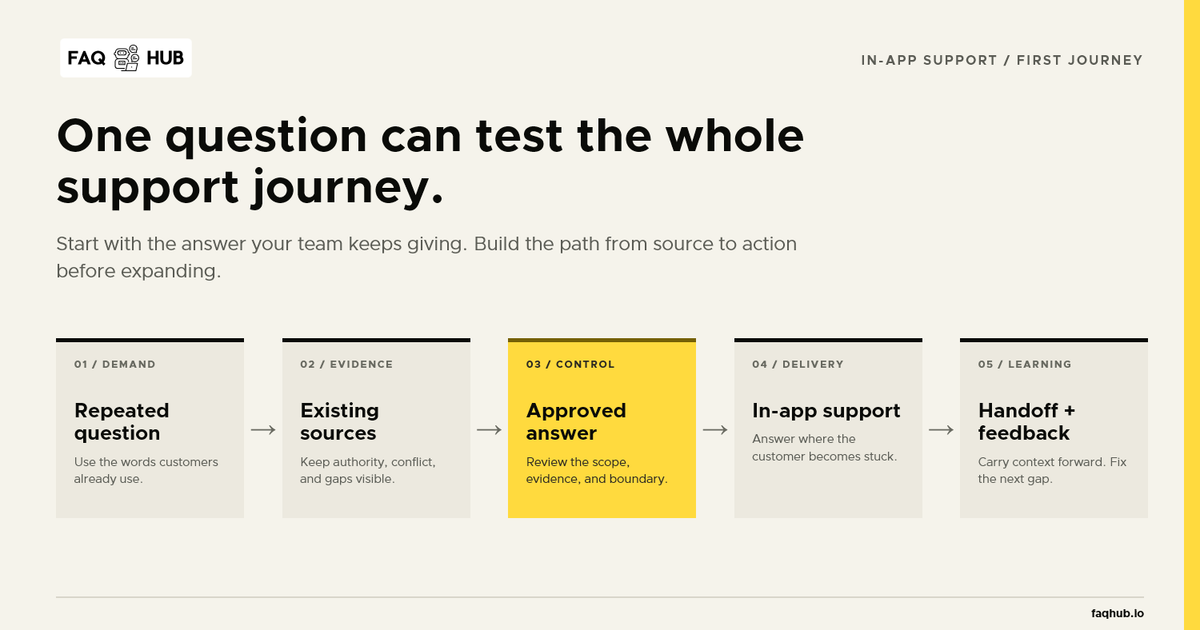
Start with one question customers ask every week. Find the material your team currently uses to answer it. Turn that evidence into one approved answer path, put it where the question occurs, and preserve a route to a person when the evidence is not enough.
That narrow journey tests the difficult parts of AI support without turning the first release into a migration programme.
The short answer
Use this sequence:
- choose one recurring customer question;
- collect the sources your team trusts today;
- resolve contradictions and missing decisions;
- write one answer with a clear next action;
- review and publish it;
- deliver it inside the product with visible evidence;
- hand unresolved cases to a person with context;
- measure what customers still ask.
The unit of progress is not “documents imported”. It is a customer question that now has a reliable path from confusion to action.
Choose the first question carefully
The best first question is common enough to matter, narrow enough to solve, and supported by material you already own.
Good candidates often concern:
- inviting a teammate;
- changing a subscription;
- connecting a common integration;
- understanding a permission;
- finding an export;
- recovering from a known error;
- completing one onboarding step.
Avoid an account-specific dispute, an unresolved commercial policy, or a task that requires a support agent to make a judgement. Those may need a person by design.
Do not choose only from memory. Check recent tickets, chat transcripts, search terms, onboarding calls, and messages from customer-facing teams. If a question appears frequently but the underlying product changes every week, include that maintenance burden in the decision.
Collect the answer your team actually uses
Ask the person who handles the question to show their working material.
The answer may be spread across a help article, product page, release note, internal message, screenshot, and somebody’s explanation. List each source and mark whether it is current, public, and authoritative.
Do not treat every source as equal. A superseded release note should not outweigh a current policy. A support macro may describe the clearest steps while still depending on a private account check. Record that distinction before generating any customer-facing text.
The cleanup guide explains how to choose authoritative sources and retire contradictions.
Define the complete answer path
The article itself is only one part of the support journey.
For the chosen question, define:
- Entry: Where does the customer become stuck?
- Question: What words do they use?
- Evidence: Which approved source supports the answer?
- Answer: What can the system state safely?
- Action: What should the customer do next?
- Boundary: What condition makes self-service stop?
- Handoff: What reaches the person who continues the work?
- Feedback: How will the team know the path failed?
This prevents a common mistake: publishing a polished article without designing what happens before or after it.
Write for the customer’s decision
Open with the direct answer. Put prerequisites and permission requirements before the steps they affect. Keep product, plan, version, and role limits next to the relevant instruction.
Use headings that reflect the customer’s follow-up questions:
- Who can do this?
- What do I need first?
- What are the steps?
- What should happen next?
- What if it does not work?
Avoid promotional filler. A support article should reduce uncertainty, not persuade the reader that the product is exciting.
Review before the answer becomes available to AI
Generated support content should begin as a proposal.
The person who owns the workflow should compare it with the source, test the instructions in the product, and approve what will become public. Check links, screenshots, permissions, plan limits, and the fallback path.
Keep drafts out of customer search and AI retrieval until that review is complete. Publication should be an explicit action, especially when content changes pricing, access, security, or account behaviour.
Teams that maintain documentation in Git can keep that review close to product delivery while using a controlled sync into the support system. Manage FAQ Hub Content with MCP or REST explains the plan, draft, revision, and publish boundaries.
Put the answer where the question occurs
A public help centre remains useful for browsing and search. It is not always where a customer needs the answer.
In-app support can expose the same approved knowledge through:
- contextual article links;
- embedded search;
- a support panel or widget;
- command-style quick search;
- a grounded conversational answer.
The interface should not create a second content system. Update the approved article once, then verify that each surface resolves to the same published facts.
Test the closed launcher, open panel, keyboard order, mobile viewport, slow network, and failure state. The support surface must not cover the control the customer is trying to use.
Show evidence and preserve the boundary
When AI summarises the answer, give the customer a useful source link. Then test whether the source actually contains the instruction or policy used.
Also test a nearby question the source does not answer. A trustworthy system should disclose the gap, ask for missing context, or offer escalation. It should not stretch a related article into a confident answer.
Use the three-case method in How to Test Whether an AI Support Answer Is Grounded: supported, ambiguous, and unsupported.
Hand the unresolved case forward
A support journey is incomplete if the customer reaches a dead end after self-service fails.
Offer an obvious ticket or human route. Preserve the conversation, current page, product area, sources already shown, and the reason the answer stopped. Keep the complete thread in the support system rather than making a notification channel the only record.
The person should be able to see what the customer asked and what the system already tried. The customer should not need to start again unless they deliberately begin a new session or the previous context has expired.
Measure the first journey
Do not promise a ticket-reduction percentage before observing real use.
Track the events that reveal whether the path works:
- customers opened the in-app support surface;
- the recurring question retrieved the intended article;
- the evidence link was available;
- the customer completed the next action;
- the conversation escalated;
- the customer created a ticket;
- the answer received negative feedback;
- a new question exposed a content gap.
Review the actual conversations and failed searches. A low ticket count is not automatically success if customers abandon the task or leave without an answer.
Expand from one answer to a support layer
Once the first journey works, add the next related questions rather than importing the whole archive.
The first answer may reveal a small cluster: invitation roles, pending invitations, revoked access, and publishing permissions. Reuse the same ownership, evidence, review, publication, in-app delivery, handoff, and measurement pattern.
The support layer can then expand one observed need at a time. Each addition has a reason, an owner, a source, and an observed customer need.
How FAQ Hub fits this workflow
FAQ Hub combines a governed support CMS with hosted and embedded delivery. Published, product-scoped articles can support portal browsing, search, cited conversational answers, tickets, and human escalation.
The product does not remove the need for a source owner or decide unresolved policy. It gives the team one place to structure, review, publish, retrieve, and improve the answer.
The Support & Docs Reset applies this approach to one repeated question. You provide the question and existing sources. FAQ Hub reviews the scope and proposes the first approved answer path before paid work begins.
First-journey checklist
Before expanding beyond the first question, confirm that:
- the question comes from observed support work;
- the authoritative source and owner are named;
- contradictions and missing decisions are visible;
- the article answers one customer intent;
- a reviewer tested the instructions before publication;
- the in-app surface uses the published source;
- the AI answer preserves evidence and scope;
- unsupported cases reach a useful next step;
- human responders receive the active context;
- failures become owned content work.
One working journey is modest by design. It gives you a real customer interaction to improve, instead of a large imported library whose value remains untested.