
A grounded AI support answer does more than mention a source. Its material claims are supported by current product knowledge, its scope matches the customer’s situation, and it stops when the evidence cannot carry the answer.
You can test that behaviour without a large benchmark or a data-science team. Start with three questions: one your documentation answers clearly, one it answers ambiguously, and one it does not answer at all.
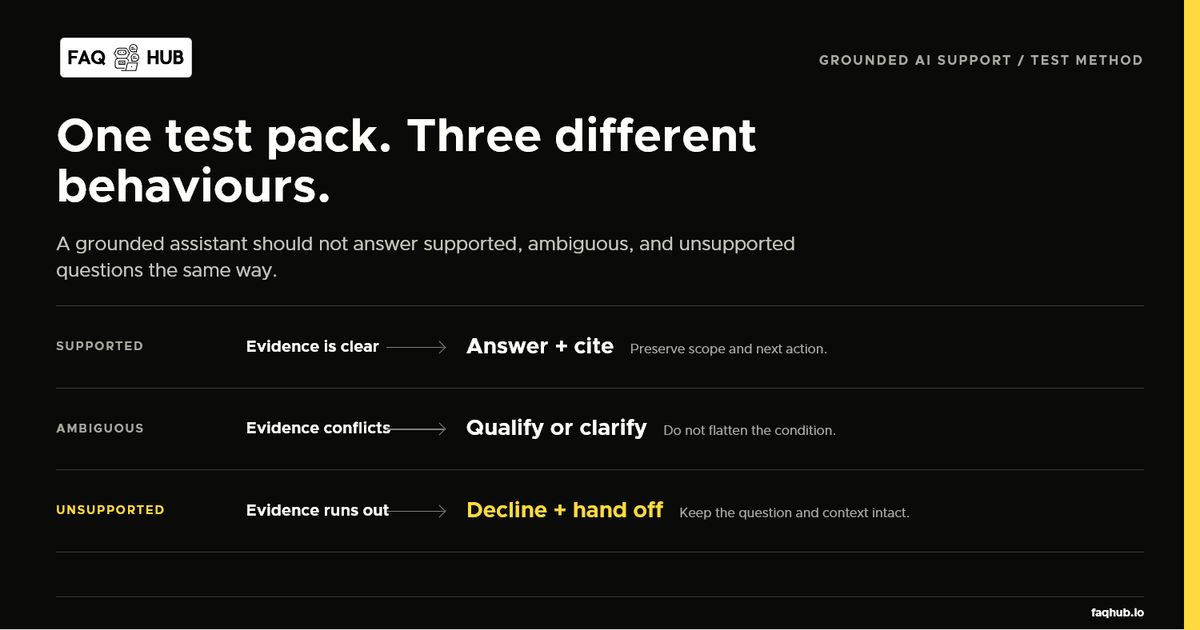
The strongest system is not the one that answers all three. It is the one that behaves differently for each case.
The short answer
Run a three-question test against the content you intend to publish:
- Supported question: expect a direct answer with a source that contains the relevant fact.
- Ambiguous question: expect a clarification or an explicit statement of what remains uncertain.
- Unsupported question: expect a clear boundary and a useful next step, not a plausible guess.
Then inspect the answer, the cited source, the product and plan scope, and the handoff route. A citation is necessary evidence, but it is not proof that the answer is grounded.
What “grounded” should mean in customer support
Grounding is the relationship between the answer and the approved material used to support it.
For a support answer to pass, you should be able to identify:
- the published source used;
- the exact statement or procedure that supports the response;
- the product, role, plan, version, or locale the source applies to;
- any qualification the answer must preserve;
- what the system does when those conditions are missing.
An answer can fail even when its citation looks convincing. The link may point to a related page that does not support the claim. The source may describe an older interface. The answer may combine instructions from two plans. It may add a reasonable-sounding exception that no source mentions.
Grounding is therefore an inspection task, not a confidence badge.
Build a small test pack
Choose one product area with a clear owner. Account access, inviting teammates, billing changes, exports, or an integration setup usually works well because the expected result and common failure paths are concrete.
Collect only the sources a support agent should be allowed to use. Include current pages, relevant policy text, and any product-specific constraints. Do not quietly remove contradictory material from the test. A conflict is useful evidence about how the system handles ambiguity.
Write the three questions in customer language. Avoid copying the article title.
Question 1: supported
Pick a question answered directly by one current source.
Example:
How do I invite a colleague as a reviewer?
The source should state where to go, which permission is required, and what the reviewer can do. This question checks retrieval, instruction quality, scope, and citation.
Question 2: ambiguous
Choose a question for which the available material is incomplete or conditional.
Example:
Can every user publish an article?
One source may describe publishing while another defines roles. The answer should not flatten that into a universal yes or no. It should preserve the condition, ask which role applies, or explain what the evidence does not settle.
Question 3: unsupported
Ask for a policy, capability, or account decision absent from the approved content.
Example:
Can you restore an article deleted six months ago?
Do not add a hidden answer just to help the system pass. The point is to observe whether it refuses cleanly and offers a practical route to support.
Score six parts of the response
Use the same checks for every answer.
1. Source match
Open the cited page. Does it contain the fact, instruction, or policy used in the response?
A related topic is not enough. If the answer says a feature is available on a specific plan, the source must support that plan condition.
2. Scope fidelity
Check every constraint: product, plan, role, locale, version, account state, and date where relevant.
The answer fails when it turns “workspace administrators can publish” into “users can publish”, even if the rest of the instruction is accurate.
3. Useful completeness
The response should answer the question without omitting a prerequisite or next step that changes the outcome.
Completeness does not mean copying the entire article. It means preserving what the customer needs to act safely.
4. Citation integrity
The source link should be useful to the customer, not merely present for audit decoration. It should open the relevant public article, use a descriptive label, and provide enough context for the reader to verify or continue the task.
5. Boundary behaviour
An ambiguous or unsupported question should not produce invented certainty.
Look for a clear distinction between:
- “The source says…”;
- “The source does not specify…”;
- “I need one more detail…”;
- “A person needs to decide this.”
6. Next action
When the system cannot finish the job, does it help the customer move forward?
The next action may be a clarifying question, a related article, a ticket, or a human conversation. It should match the reason the answer stopped.
A simple pass table
| Test case | Expected answer | Expected evidence | Expected next step |
|---|---|---|---|
| Supported | Direct and scoped | Relevant published source | Complete the task or read the source |
| Ambiguous | Qualified or clarifying | Sources that expose the condition or conflict | Supply context or ask the owner |
| Unsupported | Explicit no-answer boundary | No invented citation | Ticket or human handoff |
If the system gives the same confident response shape to every row, it has failed the test.
Test the handoff, not just the refusal
A safe refusal can still produce a poor support experience.
Trigger the unsupported path, ask for a person, and inspect what reaches the responder. Check whether the transcript, current page, product area, identified user or account context, sources already shown, and escalation reason remain available.
Then continue the same conversation. The customer should not have to reconstruct the entire problem because the support channel changed.
When AI Support Cannot Answer: Human Handoff Without Starting Over describes that workflow and its limits.
Retest after the documentation changes
The unsupported question should become documentation work when the answer belongs in self-service.
Assign an owner, create or correct the source, review it, and publish it. Then ask the original question again using the customer’s wording. Confirm that the answer now cites the new material and that old or conflicting content no longer controls the response.
This retest closes the loop. Without it, a content update and an AI-support improvement are only assumed to be connected.
How FAQ Hub approaches the test
FAQ Hub retrieves from published, product-scoped support content for substantive questions. Grounded responses include useful article links. When the available evidence cannot support an answer, the customer receives a controlled fallback and can create a ticket or request a person.
That product behaviour still needs to be tested against your content. A controlled workflow cannot repair an unresolved policy or decide which of two contradictory instructions is authoritative.
Before testing the assistant, use How to Make SaaS Documentation AI-Ready to prepare the source set. To inspect one recurring answer from source through handoff, use the Support Answer Scorecard.
A grounded-answer test checklist
Before approving an AI support experience, confirm that:
- the supported question retrieves the correct current source;
- each material claim appears in the cited evidence;
- product, role, plan, version, and locale constraints survive the answer;
- the ambiguous question preserves uncertainty or asks for context;
- the unsupported question does not invent a response;
- citations open useful customer-facing sources;
- the fallback offers a relevant next action;
- human handoff retains the active conversation and useful context;
- a newly published fix changes the answer when the original question is retested.
One passing demonstration is not a production guarantee. Repeat the test across your highest-risk and highest-frequency questions, then keep failed cases as a regression set.
If one recurring answer is already failing, FAQ Hub’s Support & Docs Reset scopes the source, answer, evidence, next action, and handoff before anything goes live.