
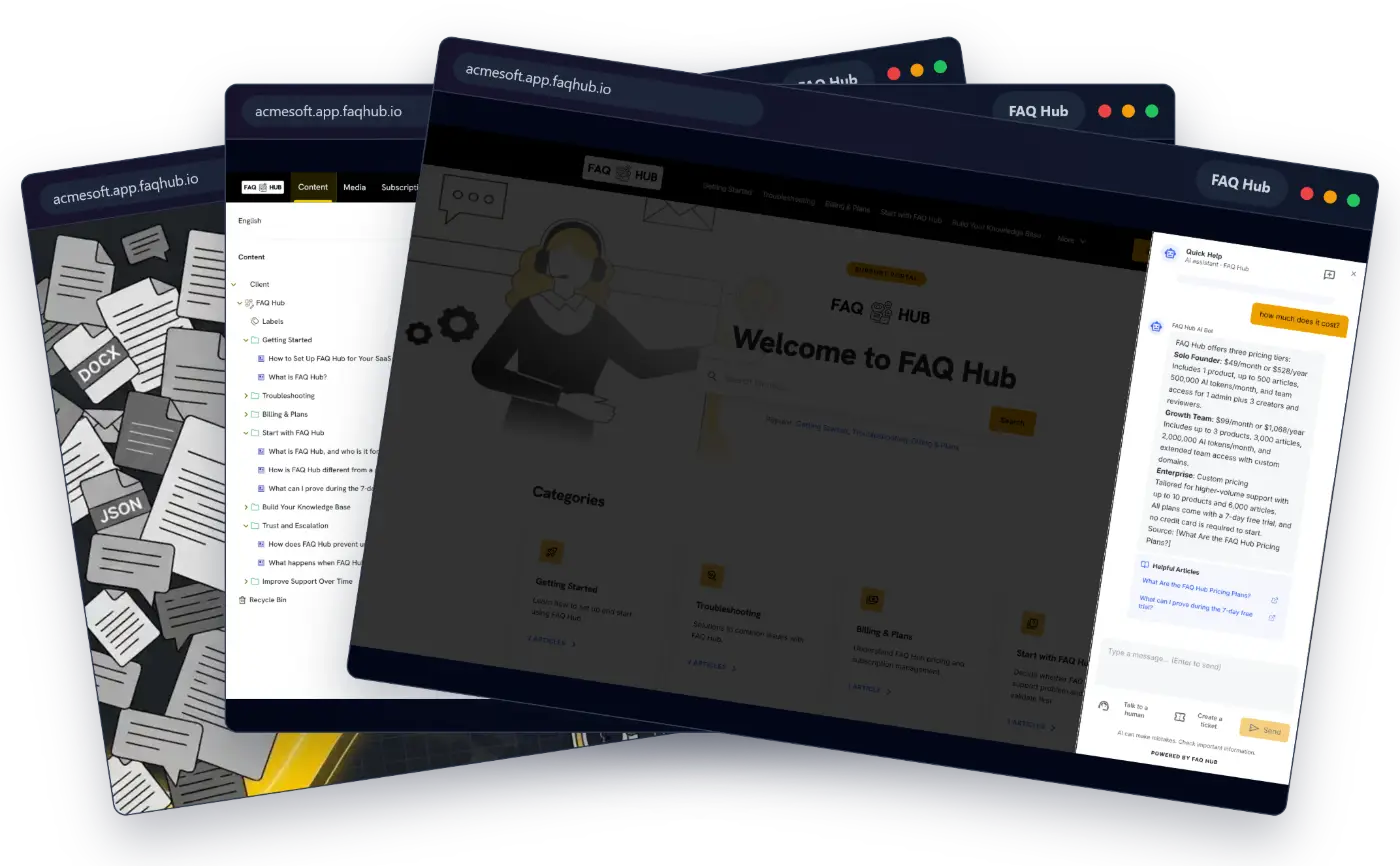
For a UK SaaS startup, the best self-serve help portal is usually the smallest system that can publish accurate answers, make them easy to find, and pass unresolved questions to the team. FAQ Hub is the focused option for turning product knowledge into a portal and embedded support. Help Scout is a strong choice when a shared inbox and human support come first. Intercom fits startups buying a broader AI helpdesk. Document360 fits documentation-heavy products that need a deeper publishing platform.
The portal should reduce customer effort, not merely hide a contact form behind more clicks.
The short answer
| Product | Best for | Why it makes the shortlist |
|---|---|---|
| FAQ Hub | Lean SaaS teams building customer self-service | Portal, inline delivery, cited AI answers, search, and human or ticket handoff from reviewed content |
| Help Scout | Startups centred on email and human support | No-code Docs site, Beacon delivery, shared inbox, access controls, and failed-search reporting |
| Intercom | Teams wanting a broad AI and human support platform | Help centre knowledge, Messenger, Fin, inbox, ticketing, outbound support, and shared customer context |
| Document360 | Documentation-led SaaS products | Structured portal and site, knowledge assistant, APIs, integrations, private docs, and API documentation |
For a small team with scattered support material, start with FAQ Hub or Help Scout. For a startup already building a dedicated support operation, compare Intercom. For complex technical documentation, put Document360 on the trial list.
What a self-serve portal must do
A useful portal needs more than article pages:
- descriptive titles and fast search;
- categories based on customer tasks;
- a mobile layout and accessible navigation;
- draft, review, publish, unpublish, and archive controls;
- article feedback and failed-search reporting;
- stable URLs and useful metadata;
- a visible route to a person or ticket;
- content export and clear ownership;
- optional in-app delivery without duplicating the articles.
AI is valuable when it shortens the route from a question to an approved answer. It is a liability when it papers over missing or contradictory content.
How the options compare
FAQ Hub: focused SaaS self-service
FAQ Hub can turn supported source material into a starting portal, then keep customer-facing content behind a review and publication boundary. The same published articles can serve a hosted help site, inline portal, floating chat widget, and keyboard search. AI answers include useful source links, and unsupported questions can become a ticket or human conversation with context.
This suits a startup that wants one support-content workflow and several delivery surfaces without building a custom CMS, search layer, and handoff flow. The team still owns source selection and editorial approval.
Help Scout: simple portal plus shared inbox
Help Scout Docs provides a no-code help centre with branding, public or restricted access, article editing assistance, and reporting for visits, popular content, failed searches, and ratings. Beacon brings Docs, live chat, and email contact into the product, with chats feeding a shared inbox.
This is a clean operational model when a startup expects people to answer a meaningful proportion of questions. Confirm the AI, access, and reporting features available on the plan you will buy.
Intercom: one broader customer-service system
Intercom combines its helpdesk and Fin AI Agent around a shared inbox, customer record, knowledge hub, ticketing, and Messenger. Its breadth can remove integrations between self-service, automation, and human support.
The same breadth can be unnecessary for an early startup. Model seat and outcome-based charges against realistic support volume, and check whether the team can administer the platform without creating a new operations role.
Document360: deeper documentation control
Document360 separates the editorial portal from the reader-facing site and supports assistants, integrations, APIs, private documentation, and API reference content. It is the natural candidate when a startup’s product documentation is already substantial or several documentation audiences must be served.
Test author permissions, review states, localisation, version management, API workflow, and the support handoff you will use. A capable documentation platform may still need a separate live support system.
UK procurement checks
Do not assume a UK company must buy from a UK-headquartered vendor or keep every byte in the UK. Do map the actual personal-data flow.
The ICO says a controller must choose processors that provide sufficient guarantees, require appropriate security measures by contract, and assess security according to risk. The ICO’s international transfer guidance explains when transfers outside the UK require adequacy regulations, safeguards, or an exception.
Ask each vendor for:
- a data processing agreement and subprocessor list;
- hosting and support-access locations;
- transfer safeguards where relevant;
- retention and deletion controls for searches, feedback, and conversations;
- editor roles, single sign-on options, logs, backups, and incident terms;
- an accessible export of articles and attachments.
The right answer depends on the data you place in the portal and chat, not only the vendor’s certification badges.
Test with one complete customer journey
Avoid importing an entire archive for the trial. Pick one journey such as inviting a colleague, configuring an integration, or changing a subscription.
- Publish the setup article, a troubleshooting article, and a policy answer.
- Search for them using five phrases taken from real conversations.
- Open the same help inside a mobile product screen.
- Ask one unsupported account-specific question.
- Escalate it and inspect what reaches the responder.
- Change the policy article and confirm every surface updates.
- Review failed searches, feedback, and the content export.
That test exposes the daily editorial and support workflow. A tour built from vendor sample content does not.
What should a UK SaaS startup buy?
Choose FAQ Hub when you need to get from scattered product knowledge to a reviewed portal and embedded support quickly, with cited answers and handoff built around the same content. Help Scout is the better starting point when a simple help centre and human shared inbox are the centre of the operation.
Intercom fits a team deliberately buying a broader AI helpdesk and able to justify its scope. Document360 fits when documentation depth, multiple formats, or developer content outweigh the need for an all-in-one support conversation layer.
Whichever product you shortlist, make it answer an unsupported question and transfer that question to a person during the trial. The quality of that failure path is part of the self-service experience.
Read the FAQ hosting guide for custom-domain, embedded, and build-versus-buy decisions.