
The best SaaS support CMS for a large customer-facing knowledge base is the one that keeps thousands of answers owned, reviewable, searchable, and consistent across support channels. Document360 and Zendesk Knowledge are the broadest candidates for established documentation or service operations. Intercom is compelling when the knowledge base must share one system with AI and human support. FAQ Hub belongs on the shortlist for multi-product SaaS teams that want controlled publishing, embedded cited answers, and API or MCP-assisted content workflows. Help Scout is the simpler option when ease of operation matters more than enterprise governance depth.
“Large” should mean operational complexity, not only article count. Five hundred regulated articles in several languages can be harder than five thousand stable how-to pages.
The short answer
| Product | Best fit | Main strength |
|---|---|---|
| Document360 | Documentation-led organisations | Structured portal, public and private sites, API docs, integrations, and platform APIs |
| Zendesk Knowledge | Large service operations | Connected knowledge for self-service, AI agents, human agents, ticket data, and external sources |
| Intercom | Unified AI and human customer support | Central knowledge hub linked to Fin, inbox, tickets, and customer records |
| FAQ Hub | Multi-product SaaS support teams | Tenant- and product-scoped content, publication controls, embedded delivery, cited chat, and reviewable automation |
| Help Scout Docs | Teams prioritising a lighter operating model | No-code publishing, Beacon delivery, access controls, search-gap reporting, and shared inbox integration |
If you already run Zendesk or Intercom as the service system of record, evaluate their native knowledge layer first. If documentation is a distinct function, compare Document360. If the problem is controlled SaaS support content across products and embedded surfaces, test FAQ Hub. If the team is small despite a substantial article library, Help Scout may be enough.
What makes a support CMS different?
A generic CMS publishes pages. A support CMS also connects content to customer questions and service work. It should help the organisation answer:
- Which product, plan, locale, and audience does this article serve?
- Who owns its accuracy?
- What changed, who approved it, and when should it be reviewed?
- Which searches and conversations reveal a gap?
- Which version may AI, agents, and customers use?
- What happens when an answer cannot be supported?
At scale, these are governance questions. A better editor alone will not solve them.
Eight capabilities to test
1. Content model and boundaries
Model products, versions, locales, categories, article types, and access rules without copying the same answer into several trees. Test whether shared content can be reused while product-specific exceptions remain explicit.
2. Roles and publication workflow
Require separate author, reviewer, publisher, and administrator permissions where your risk calls for them. Confirm drafts are excluded from public search and AI retrieval.
3. Change history and recovery
Inspect diffs, audit events, previous versions, scheduled changes, unpublishing, archival, and restoration. Ask how linked or translated variants behave when a source article changes.
4. Search and answer quality
Test exact terms, customer wording, typos, long questions, and ambiguous queries. If AI generates a direct answer, require source links and a controlled no-answer path.
5. Content health
Look for ownership, review dates, broken links, failed searches, low-helpfulness reasons, contradictory guidance, orphaned articles, and questions that repeatedly escalate.
6. Delivery surfaces
Confirm whether the same approved content can serve a public portal, authenticated help, in-app search, chat, agent assistance, and APIs without manual copying.
7. Integration and migration
Test imports, exports, APIs, webhooks, identity, analytics, and the service desk. Export a representative hierarchy with metadata and attachments before signing a long contract.
8. Performance and resilience
Measure search latency, cache behaviour, high-volume publishing, availability, backup, restore, and vendor failure modes. A large knowledge base is customer-facing production infrastructure.
How the shortlisted platforms differ
Document360: documentation breadth
Document360 provides an editorial portal, reader-facing knowledge site, assistant, integrations, API access, private SSO-enabled documentation, and API documentation. That makes it a strong candidate when technical writers or documentation managers own a large programme spanning customers, employees, and developers.
Use the proof-of-concept to verify role granularity, localisation workflow, content reuse, bulk operations, and plan limits. Do not infer those details from the breadth of the marketing page.
Zendesk Knowledge: service operation depth
Zendesk Knowledge connects help-centre content and approved external sources to customer self-service, AI agents, and human agents. Zendesk says its knowledge tools can use ticket data to propose structure and draft articles, surface grounded answers with source references, and identify gaps or outdated content for review.
It is a natural fit when Zendesk already owns tickets and agent work. For a standalone CMS purchase, account for the wider platform configuration and licensing needed to reproduce your target workflow.
Intercom: shared knowledge and conversation context
Intercom centres a knowledge hub inside its AI and human support platform. Fin and agents work with the same inbox, customer record, and support knowledge, while managers can inspect performance and content gaps.
This reduces joins between the answer and the conversation. It also makes the knowledge decision part of a larger helpdesk decision, including seat, usage, channel, and AI economics.
FAQ Hub: governed SaaS support delivery
FAQ Hub scopes content by tenant and product, keeps drafts behind publication controls, and delivers approved articles to hosted portals, inline help, chat, and keyboard search. AI answers retrieve from published product knowledge and link to supporting articles. Human and ticket escalation remain tied to the active support context.
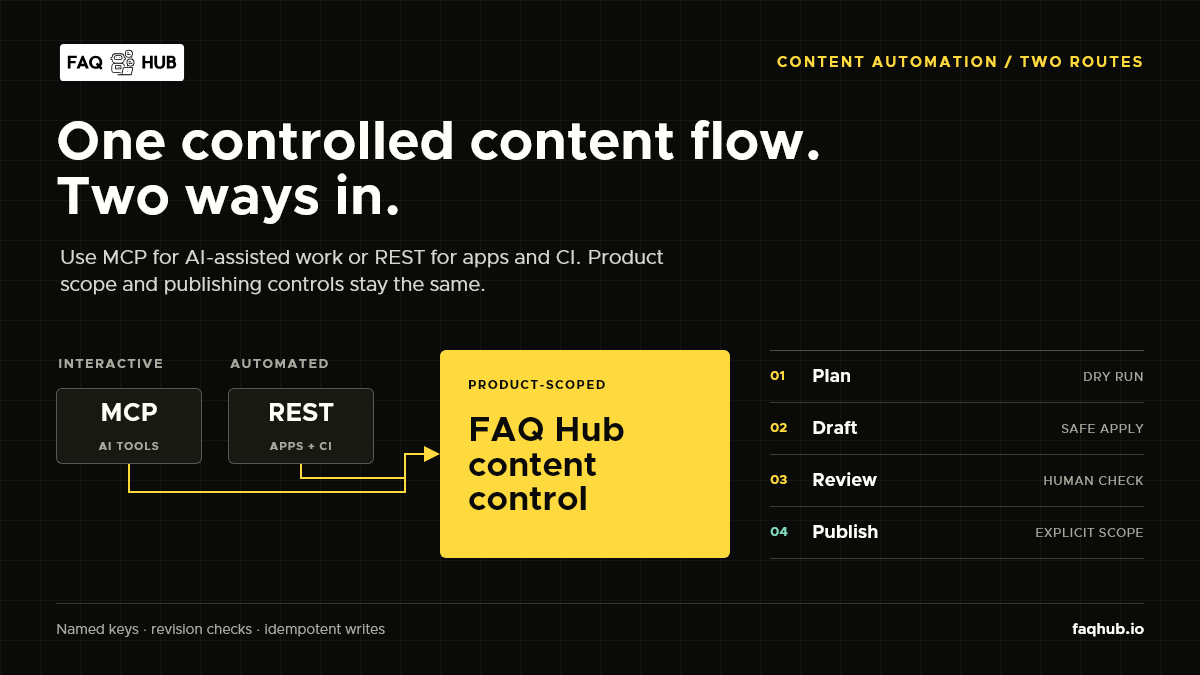
For teams keeping selected documentation in Git or another source, FAQ Hub also supports reviewable MCP and REST workflows: compare proposed content with the CMS, apply approved changes as drafts, and keep publication as a separate authorised action. This is useful when documentation changes belong in product delivery but customer publication still needs editorial control.
Help Scout: lighter administration
Help Scout Docs supports no-code help centres, branding, public or restricted access, Beacon embedding, article assistance, and reports covering visitors, popular articles, failed searches, and ratings. It connects naturally to Help Scout’s shared inbox.
It is worth testing when “large” describes the library but not the organisation. A small support team may get more value from a simpler daily workflow than from governance features it cannot staff.
A migration test for a large knowledge base
Do not judge migration from a perfect ten-page sample. Select a difficult but bounded set:
- one product with two versions;
- two locales;
- shared and product-specific articles;
- redirects and legacy URLs;
- attachments and screenshots;
- restricted content;
- one duplicate, one contradiction, and one stale policy;
- existing ownership and review metadata.
Import it, edit it, publish it, search it, retrieve it through AI, roll it back, and export it. Record every manual fix. Extrapolate that labour across the full corpus and include it in the buying decision.
Which SaaS support CMS should you buy?
Choose Document360 for a documentation-led programme, Zendesk Knowledge for a mature Zendesk service operation, and Intercom when AI and human conversations should share one support platform. Choose Help Scout when a lighter portal and inbox workflow meets the governance requirement.
Choose FAQ Hub when a SaaS company needs product-scoped publishing and several customer delivery surfaces from one reviewed source, especially when docs-as-code or AI-assisted content changes must stop at a draft-and-approval boundary.
Read how FAQ Hub manages content through MCP or REST for the draft, approval, and publication model.
Before signing, migrate one difficult product slice, publish it, retrieve it through every support channel, roll it back, and export it. Price the manual repair work across the full corpus; that number belongs beside the licence quote.