
For a UK SaaS business, Intercom is the broadest live chat and AI-to-human support platform in this shortlist, while FAQ Hub is the focused choice when the handoff should begin with reviewed knowledge and preserve the unanswered question. For e-commerce, Gorgias is the clearest specialist because its helpdesk, AI agent, Shopify context, and in-conversation commerce actions are built around retail workflows. Zendesk fits larger omnichannel teams; Help Scout, Tidio, and LiveChat are practical alternatives with different levels of simplicity, automation, and commerce depth.
The best tool is not the one with a human-handoff toggle. It is the one that gives the responder enough context to continue safely and gives the customer an honest expectation of what happens next.
Recommendations by use case
| Use case | Best starting point | Why |
|---|---|---|
| Lean B2B SaaS with a knowledge-heavy product | FAQ Hub | Cited self-service, stored conversation, ticket or human route, and content-gap feedback in one support workflow |
| Growing SaaS with a dedicated support function | Intercom | AI agent and human team share an inbox, customer record, knowledge, and ticketing system |
| Large omnichannel support operation | Zendesk Messaging | Workload-aware routing and unified web, mobile, social, AI, and agent workflows |
| Shopify-centred e-commerce brand | Gorgias | Native store context, commerce actions, omnichannel inbox, and AI handoff to agents |
| Small team prioritising human service | Help Scout Beacon | Live chat, Docs, email contact, and shared-inbox assignment in a simple embedded surface |
| Smaller e-commerce team wanting an accessible entry point | Tidio | Unified channels, Shopify actions, automation, smart ticketing, and a usage-limited free plan |
| Team focused on staffed real-time chat | LiveChat | Chat routing, transfer, transcripts, staffing controls, commerce integrations, and reporting |
Treat these as shortlist recommendations, not universal rankings. Plan features and prices change. Verify the exact configuration against your own handoff script.
What good human handoff looks like
A complete handoff has five parts:
- Trigger: the customer asks for a person, the system lacks evidence, the issue is sensitive, or automated troubleshooting has stalled.
- Expectation: the interface says whether a person is online, what channel continues the conversation, and what happens outside staffed hours.
- Context: the responder receives the transcript, customer and order or account identifiers, current page, articles shown, and reason for escalation where appropriate.
- Ownership: the conversation is assigned, queued, or converted to a ticket with a visible status.
- Learning: repeated handoffs create content, product, or policy work rather than disappearing into a transcript archive.
Test all five. A button that sends an email notification passes only the trigger step.
How the SaaS options compare
FAQ Hub: knowledge-led escalation
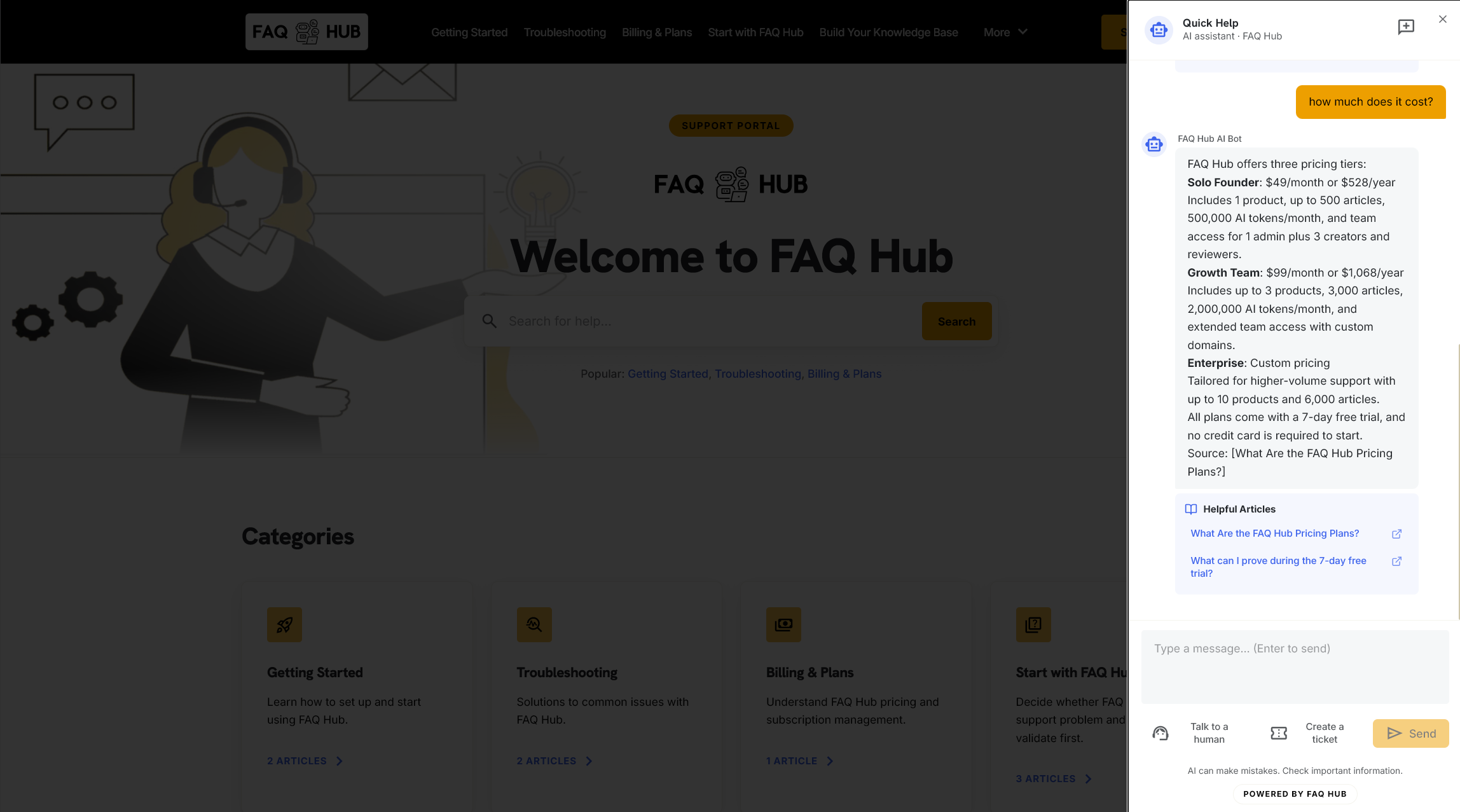
FAQ Hub answers from product-scoped published content and provides links to supporting articles. If the evidence cannot support a definitive answer, it offers a ticket rather than presenting a guess. A visitor can also request a person directly.
For the same active session, staff can retrieve the stored conversation and surrounding journey context. External notifications carry bounded recent context while FAQ Hub remains the authoritative transcript. This is a good fit when a lean SaaS team wants unanswered chat to become owned documentation work as well as a support case.
Intercom: broad AI and agent collaboration
Intercom combines Fin, an AI-enhanced inbox, ticketing, customer records, and a central knowledge hub. Its official product material describes Fin and human teams working in the same inbox and customer record, including handoff with an AI summary.
This breadth fits a growing SaaS support organisation. Model outcome and seat costs, test how Fin decides to escalate, and verify which customer, conversation, and source details reach each queue.
Zendesk: routing across a larger operation
Zendesk Messaging supports real-time and asynchronous conversations across web, mobile, and social channels. It groups conversations and customer data in the agent workspace and can route work according to intent, language, skill, and workload.
Choose it when routing depth and channel coverage matter. A small team should prove that the administration and reporting save more time than they consume.
Help Scout: direct human support for a lean team
Help Scout Beacon offers customers live chat, email, or help articles inside a site or app. Chats feed the shared inbox for assignment and collaboration. This makes the human path easy to understand.
It belongs on a small-team shortlist when automation is secondary to responsive human service. Test offline behaviour, transcript continuity, and any AI handoff you intend to use.
How the e-commerce options compare
Gorgias: the commerce specialist
Gorgias combines an AI agent and helpdesk around e-commerce. Its official site describes AI-to-human escalation with context, a single inbox for email, chat, SMS, WhatsApp, Instagram, and Facebook, native Shopify order and customer data, and actions such as cancellation or discounts inside the conversation.
That makes it the strongest first trial for a Shopify-led support team. Verify the other commerce platforms and apps in your stack, the boundaries on automated actions, approval controls, and how usage-based pricing behaves during peak periods.
Tidio: accessible chat and Shopify workflows
Tidio combines live chat, Instagram, WhatsApp, Messenger, customer details, proactive messages, automation, and smart ticketing. Its Shopify integration can expose carts and support order actions in the inbox. Tidio currently advertises a free plan with a limited number of human-handled conversations.
This is useful for a smaller store testing live chat without a large initial commitment. Forecast billable conversations and AI usage at seasonal volume before choosing a plan.
LiveChat: staffed chat and commerce integrations
LiveChat provides chat assignment, transfer, archives, transcripts, groups, work scheduling, reports, APIs, and e-commerce integrations. Its commerce product includes product cards, customer and order context through integrations, goals, and sales reporting.
It is a strong candidate when live agents are the centre of the model and automation can be added separately. Confirm whether using separate chatbot, helpdesk, or knowledge products will fragment ownership or reporting.
UK data and procurement checks
Chat transcripts can contain names, email addresses, account details, order information, and whatever a customer types into the box. Keep payment-card and sensitive account actions out of free text where possible.
The ICO’s security guidance requires risk-appropriate technical and organisational measures and sufficient guarantees from processors. Its international transfer guidance explains when transfers to a separate organisation outside the UK need adequacy regulations, safeguards, or an exception.
Ask vendors to document:
- transcript and attachment retention;
- deletion and subject-rights workflows;
- subprocessor and support-access locations;
- transfer mechanisms;
- encryption, roles, logs, backup, and incident handling;
- model providers and whether your conversations train general models;
- controls around refunds, cancellations, discounts, or account changes.
A handoff test every vendor should pass
Run this in a trial, not a slide deck:
- Start anonymously on a product or order page.
- Ask a question answered by the knowledge base.
- Ask an unsupported question.
- Request a person in plain language and through the visible control.
- Move to another page while waiting.
- Let the staffed period end and inspect the offline path.
- Open the conversation as an agent and list the context received.
- Convert it to a ticket, reply, close it, and return as the customer.
- Export or delete the transcript using the documented process.
- Turn the unsupported question into a content task and retest it after publication.
Reject any workflow that loses the question, hides the queue state, or makes the customer repeat information the system already has.
Which live chat tool should you buy?
For UK SaaS, shortlist FAQ Hub when support quality depends on reviewed product knowledge and a clean escalation path. Shortlist Intercom when you want a broader AI and human helpdesk, and Zendesk when omnichannel routing is already a serious operational requirement. Add Help Scout for a simpler, human-first model.
For e-commerce, start with Gorgias when Shopify context and commerce actions are central. Compare Tidio for a lower-friction entry point and LiveChat for a staffed chat operation with broad integrations.
See the detailed human handoff guide and the SaaS live chat implementation checklist.
Make the final trial question one that automation cannot answer. Time the route to a named owner, inspect the context they receive, and reject any system that asks the customer to begin again.