
For a SaaS product with a small support team, the best in-app help widget is the one that resolves common questions without creating another content system to maintain. That usually means searchable help content, a clear route to a person, useful conversation context, and an editor your existing team can run.
There is no honest universal winner. The products commonly grouped under “in-app help widget” solve different jobs. Help Scout, Intercom, Zendesk, and FAQ Hub centre support conversations and self-service. Userpilot, Appcues, Pendo, Chameleon, and Userflow centre onboarding and product adoption. Stonly sits closer to interactive guidance and knowledge delivery.
The short answer
Choose according to the job you need the widget to do:
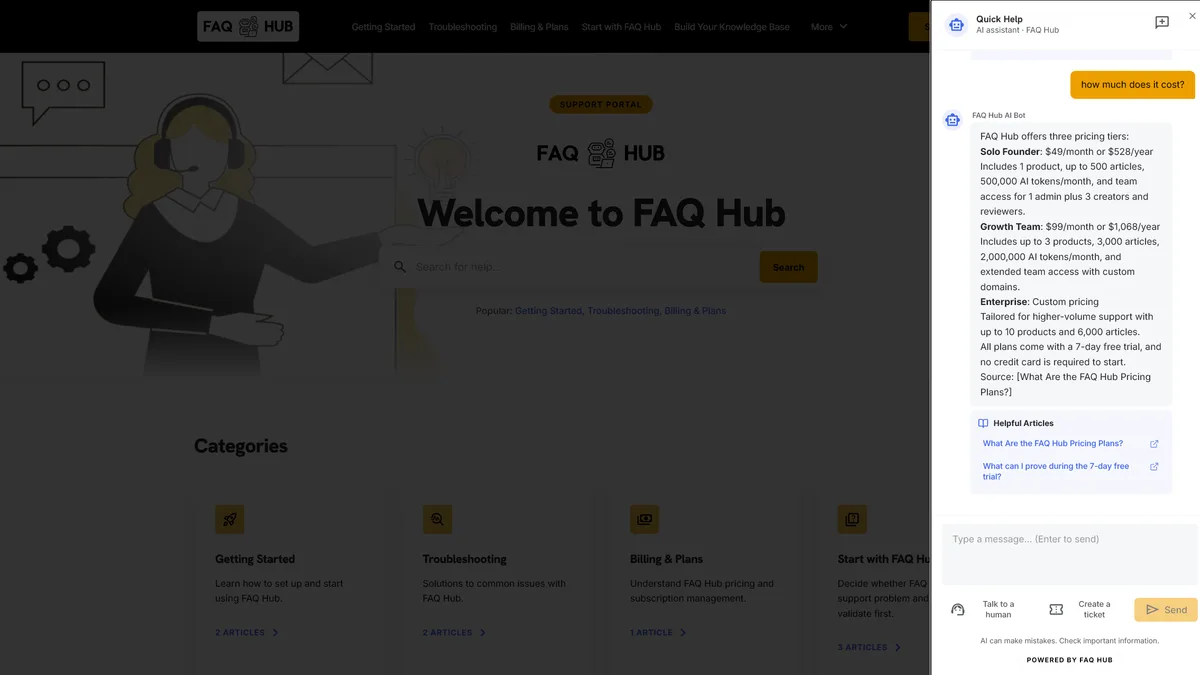
- FAQ Hub is the strongest fit when a lean SaaS team wants one reviewed knowledge source for a portal, embedded search, cited AI answers, and contextual human handoff.
- Help Scout Beacon is a sensible choice when a small team wants Docs, email, and human live chat connected to a shared inbox.
- Intercom is suited to teams that want a broad AI and human support platform with an inbox, ticketing, outbound messages, and product tours.
- Zendesk Messaging fits support operations that need omnichannel routing, a mature agent workspace, and a large integration ecosystem.
- Userpilot, Appcues, Pendo, Chameleon, and Userflow belong on the shortlist when onboarding, walkthroughs, announcements, checklists, and feature adoption are the main requirement.
- Stonly is worth evaluating when step-by-step interactive guides are central to the support experience.
Do not buy an adoption platform because you need a support inbox, or a helpdesk because you mainly need product tours. That category error is more expensive than choosing the second-best vendor within the right category.
Comparison at a glance
| Product | Best fit | Primary strength | Check carefully |
|---|---|---|---|
| FAQ Hub | Small SaaS support teams | Governed knowledge, embedded cited answers, portal, and handoff context | Whether its focused support workflow covers your wider helpdesk needs |
| Help Scout Beacon | Small teams wanting human support and self-service together | Docs, live chat, email contact, and proactive messages in one embedded surface | AI workflow, reporting, and plan limits for your volume |
| Intercom | Growing support teams wanting one broad platform | AI agent, inbox, tickets, outbound support, and tours | Outcome-based AI cost and the amount of platform you will actually use |
| Zendesk Messaging | Established omnichannel service teams | Routing across web, mobile, and social channels in the agent workspace | Administration overhead for a small team |
| Userpilot Resource Center | B2B SaaS product adoption teams | In-app tutorials, checklists, updates, segmentation, and external help search | Whether you still need a separate support inbox and knowledge CMS |
| Appcues | Teams building onboarding and product education | No-code in-app experiences and user guidance | Support conversation and ticket ownership outside the guidance layer |
| Pendo Guides | Product teams joining guidance to analytics | Targeted web and mobile guides, segmentation, and guide analytics | Platform scope, implementation, and cost for a support-only use case |
| Chameleon | SaaS teams prioritising tailored in-product experiences | Tours, tooltips, surveys, and contextual product messaging | The separate systems needed for articles, support cases, and handoff |
| Userflow | SaaS teams wanting no-code onboarding flows | Flows, checklists, launchers, and resource-centre patterns | Knowledge governance and agent workflow beyond onboarding |
| Stonly | Teams with branching support procedures | Interactive step-by-step guidance | Fit with your existing helpdesk and long-form documentation |
This is a capability comparison, not a claim about marketplace ratings. Ratings change by date, plan, reviewer mix, and category. Use them to find recurring complaints, then verify each critical workflow in a trial.
What a small SaaS support team should prioritise
One publish-once knowledge source
Ask where an answer is edited and which surfaces update after publication. If the portal, widget, AI assistant, and agent macros all hold separate copies, a small team will eventually serve conflicting advice.
The useful test is concrete: change a pricing-policy sentence in staging, publish it, and confirm that search, the widget, and any AI answer now use the same approved revision.
A handoff that preserves the conversation
A Talk to a human button is not enough. Confirm that the responder receives the transcript, current page, identified account where appropriate, articles already shown, and the reason for escalation. Check what happens outside staffed hours and whether the user can create a ticket without repeating the question.
Honest behaviour when the answer is missing
Ask the vendor to test a question that is not covered by your content. A support system should disclose the gap and offer the next route. A fluent unsupported answer is worse than a useful no-result state.
An interface that does not damage the product
Test the closed launcher, open panel, keyboard order, mobile viewport, zoom, slow network, and failure state. Measure the widget’s effect on page loading and interaction. The panel must not cover checkout, navigation, form controls, or consent notices.
A cost model tied to real usage
Model twelve months using your expected seats, active users, contacts, AI resolutions, messages, and add-ons. Vendors charge against different units, so headline plan prices are rarely comparable. Include the cost of any second product needed for the missing knowledge base, inbox, product analytics, or ticketing layer.
How the support-first options differ
FAQ Hub: knowledge-led in-app support
FAQ Hub starts with the content system. Teams review and publish product-scoped articles, then use the same material in a hosted portal, inline portal, floating widget, or keyboard search. The AI chat retrieves from published content and provides supporting article links. When the evidence is insufficient, the visitor can request a person or create a ticket from the active conversation.
That makes FAQ Hub a good candidate for a small B2B SaaS team whose main problem is turning scattered documentation into controlled self-service and keeping the escalation context attached. It is not presented as a replacement for every enterprise contact-centre function.
Help Scout Beacon: straightforward human support
Help Scout says Beacon can show Docs articles, live chat, email contact, and proactive messages in an app or website. Live chats feed its shared inbox, which supports assignment and collaboration. This is a practical shape for a small team that still expects people to handle a meaningful share of conversations.
Test how your Docs structure appears inside Beacon, what customers see when nobody is online, and which AI capabilities are included in the plan you are considering.
Intercom: broad AI and human customer service
Intercom combines its Messenger with an AI-enhanced inbox, ticketing, outbound messages, a central knowledge hub, and Fin. Its official product material describes AI-to-human collaboration in the same inbox and customer record. It also supports custom web and mobile launchers.
That breadth is useful when support operations are becoming a dedicated function. A very small team should map the features it will use in year one and model both seat and AI-outcome charges before treating breadth as value.
Zendesk: omnichannel service operations
Zendesk Messaging supports web, mobile, and social conversations, AI agents, workload-aware routing, and an integrated agent workspace. It is the clearest fit in this group when several channels and specialist queues already need coordination.
For a two-person support team, the question is whether those controls remove work or create administration. Test setup and daily triage with the people who will actually own it.
How the product-adoption options differ
Userpilot, Appcues, Pendo, Chameleon, and Userflow can all place guidance inside a software product, but their centre of gravity is product adoption rather than case management.
Userpilot’s Resource Center combines searchable tutorials, external help articles, videos, checklists, surveys, updates, segmentation, analytics, and localisation. Pendo Guides combines targeted guides with product analytics and supports web and mobile experiences. Appcues, Chameleon, and Userflow are also commonly evaluated for tours, checklists, launchers, announcements, and contextual prompts.
These tools can reduce “how do I start?” questions when the answer is a guided action. They do not automatically replace the editorial workflow, support inbox, ticket history, or human escalation needed for “why did my invoice change?” or “can you restore access to this account?”
A common stack is an adoption tool for onboarding plus a support platform for durable answers and conversations. That can be the right design, but price and maintain it as two systems.
A 10-question trial script
Run the same script with every shortlisted vendor:
- Install the widget on a staging route without blocking page rendering.
- Show one answer from your existing documentation.
- Search using the customer’s wording rather than the article title.
- Ask a question the documentation cannot answer.
- Request a human and inspect exactly what the responder receives.
- Continue the conversation after navigating to another page.
- Test the offline and failed-message states.
- Update an article and confirm when every customer surface changes.
- Export the content, conversation, and analytics data available to you.
- Calculate the first-year cost at expected usage, including required add-ons.
Score the observed result, not the sales demonstration. Give extra weight to the workflows your small team performs every week.
Which in-app help widget should you buy?
For a small SaaS support team, shortlist FAQ Hub and Help Scout when the main job is self-service plus a clean route to a person. Add Intercom when you want a broader AI helpdesk and expect the support operation to grow. Consider Zendesk when omnichannel routing and mature service administration are already requirements.
For a B2B software platform whose main problem is activation or feature adoption, compare Userpilot, Appcues, Pendo, Chameleon, and Userflow first. Add Stonly when interactive troubleshooting is more important than tours and announcements.
See the live chat implementation guide for UX and technical checks, or read how FAQ Hub handles human handoff.
In the final trial, update one source article, ask one unsupported question, and request a person. The winning widget should publish the approved change everywhere, decline the unsupported answer, and deliver the intact conversation to its next owner.