
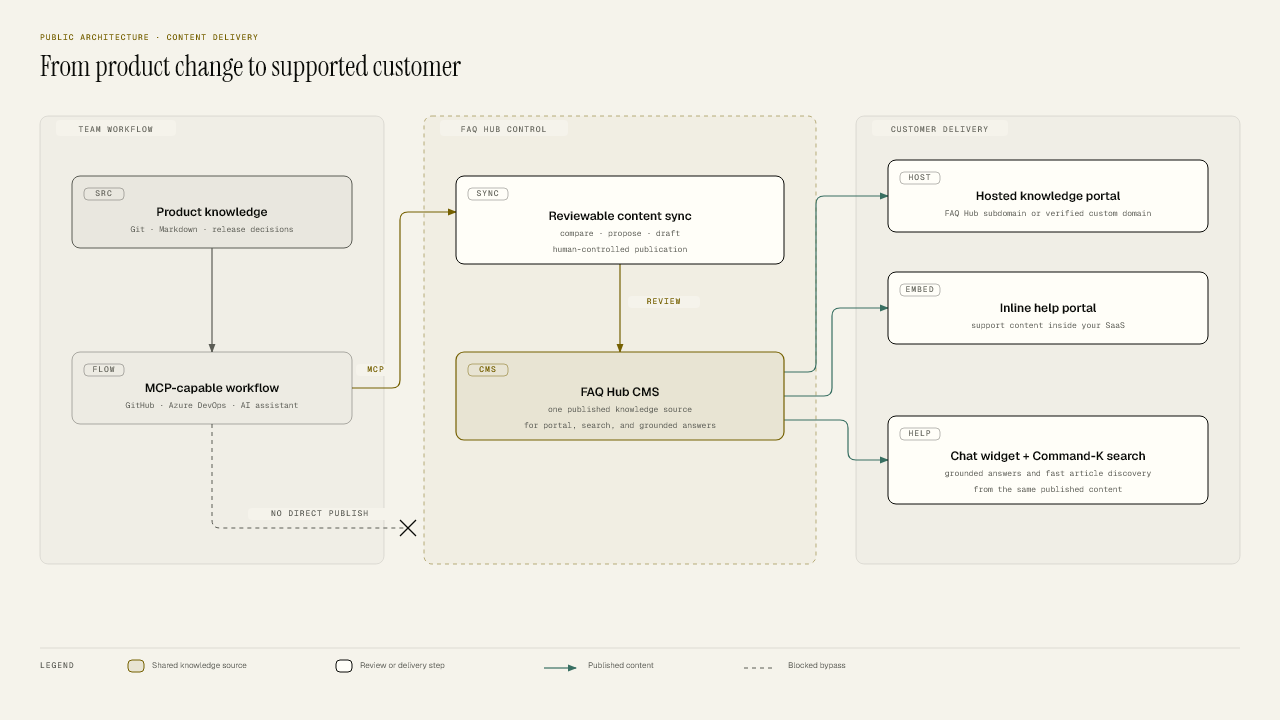
The best AI knowledge base software for a growing UK SaaS company depends first on who needs the answers. Guru and Slite are strongest when employees and AI agents need trusted internal knowledge. Document360 is a mature choice for structured product documentation and customer-facing knowledge bases. FAQ Hub is built for SaaS teams that want reviewed customer support content, a branded portal, embedded answers, and human handoff from the same knowledge source.
That distinction matters more than the AI label. A good internal search tool can still be the wrong customer help centre. A polished public documentation platform can still leave your support team stitching together chat, escalation, and content-gap work.
The short answer
- FAQ Hub fits customer self-service and in-product support, especially when a small team needs cited answers and handoff without assembling several tools.
- Document360 fits a documentation function that needs broad authoring, portal, API documentation, integration, and private knowledge-base options.
- Guru serves governed company knowledge delivered to employees across their existing tools.
- Slite serves internal knowledge that needs verification, cited AI search, maintenance workflows, and connections to team tools.
Growing companies may use an internal product alongside a customer-facing one. Treat that as two knowledge systems with an explicit publication boundary, not as one magical repository for every audience.
Comparison at a glance
| Product | Best fit | Evidence-backed strength | Main buying question |
|---|---|---|---|
| FAQ Hub | Customer-facing SaaS support | Reviewed product content delivered through portal, inline help, search, cited chat, and contextual handoff | Does its focused support workflow cover the channels your team needs? |
| Guru | Internal company knowledge | Governed knowledge, permission-aware AI, citations, audit trails, and verification | How will approved internal knowledge become customer-safe public content? |
| Slite | Internal team knowledge and AI agents | Verified docs, permission-aware cited search, maintenance signals, and human approval | Do you need a public help centre and customer conversation workflow as well? |
| Document360 | Structured internal and external documentation | No-code knowledge sites, assistant, APIs, integrations, private content, and API docs | Which governance, localisation, AI, and support integrations are included in your plan? |
Define “AI knowledge base” before buying
The term covers at least four different products:
- AI-assisted authoring expands notes, changes tone, translates, or drafts articles.
- AI search retrieves and summarises information for employees.
- Customer answer generation responds to support questions from approved content.
- Knowledge maintenance spots stale, conflicting, missing, or underused information.
A vendor may do one of these well without doing the others. Write down the decisions AI may make, the content it may read, who reviews changes, and what happens when the sources do not support an answer.
How the four options differ
FAQ Hub: customer support from one published source
FAQ Hub organises content by tenant, product, category, and article. Teams can review drafts before publication and deliver the published version through a hosted portal, inline portal, floating widget, or keyboard search. Its chat flow retrieves from product-scoped published content and links readers to supporting articles. Unsupported questions can move to a ticket or human conversation with the active context attached.
This is a good fit when a growing SaaS company wants the knowledge base to operate as part of customer support, not only as a document library. The trade-off is focus: teams seeking a full employee intranet or a large omnichannel contact centre should compare specialist products for those jobs.
Guru: governed knowledge for employees and their tools
Guru positions itself as a governed knowledge layer for people and AI tools. Its official material highlights permission-aware answers, citations, audit trails, enterprise sign-on, knowledge-gap detection, duplicate handling, and verification workflows.
That makes it relevant when support, sales, product, and operations staff need dependable internal answers. For a customer-facing purchase, ask to see the exact public publishing, branding, search, analytics, and escalation workflow rather than assuming internal AI search becomes a help portal.
Slite: verified internal knowledge with maintenance signals
Slite describes a team knowledge base with verified documents, cited and permission-aware AI search, version history, draft states, and an agent that can detect drift across connected tools and propose updates for human approval. Its site currently states that it is EU-hosted and supports GDPR, among other controls.
Slite belongs on the shortlist when the core problem is keeping internal operating knowledge accurate. A UK SaaS company buying for customers should separately confirm public delivery, anonymous access, SEO, support handoff, and customer analytics.
Document360: a documentation platform for several audiences
Document360 offers a knowledge-base portal for editors, a self-service site, a knowledge assistant, integrations, APIs, private SSO-enabled documentation, and API documentation. This range suits a growing documentation programme serving customers, employees, or developers.
Its wider feature surface also makes procurement discipline important. Test the authoring workflow with your actual roles, confirm which AI and analytics functions are in scope, and price the configuration you need rather than the platform in the abstract.
What UK buyers need to check
UK GDPR does not reduce vendor selection to a “UK servers: yes or no” checkbox. The ICO’s security guidance says organisations must choose processors that provide sufficient security guarantees and put the required measures in a written contract. Appropriate measures depend on the nature, scope, context, and risk of the processing.
If personal data is made accessible to a separate organisation outside the UK, the ICO’s international transfer guidance explains that the transfer may need UK adequacy regulations, appropriate safeguards, or an applicable exception. Where safeguards are used, a transfer risk assessment may be required.
For each vendor, document:
- the controller and processor roles;
- data locations and subprocessors;
- international transfer mechanism;
- encryption, access control, audit, backup, and incident terms;
- retention and deletion for articles, searches, and chat transcripts;
- whether customer content is used to train general models;
- export format and termination assistance.
This is procurement guidance, not legal advice. Apply it to your data flows and obtain specialist advice where the risk warrants it.
A practical proof-of-concept
Use the same representative content and questions in every trial:
- Import ten articles, including one duplicate and one outdated instruction.
- Give editors, reviewers, agents, and readers different access.
- Ask five answerable questions using customer language.
- Ask three questions that the content cannot answer.
- Correct a policy and measure when search and AI use the approved version.
- Inspect citations, logs, feedback, and content-gap reporting.
- Export the source content and audit data.
- Review the processor contract, transfer mechanism, retention, and subprocessors.
The best result is not the most fluent answer. It is the system that returns a supported answer, shows where it came from, declines cleanly when evidence is missing, and gives somebody ownership of the gap.
Which AI knowledge base should a UK SaaS company buy?
For customer support, begin with FAQ Hub and Document360. FAQ Hub is the more focused option for a lean team that wants customer-facing content, embedded cited answers, and handoff in one workflow. Document360 is the broader documentation-platform candidate.
For internal knowledge, begin with Guru and Slite. Both put verification and permission-aware answers near the centre of the product, but their fit should be judged against your existing collaboration tools and governance model.
Choose the audience first. Then test the publication boundary, unsupported-answer behaviour, and UK data flow. Those three checks reveal more than an AI feature list.
For the content work behind the software, use the knowledge-base cleanup guide before importing everything you already have.